
Lafayette County Parole vs Probation
A Lafayette County jail release does not identify the supervision type by itself. Probation is generally ordered by the court, sometimes after a suspended sentence. Parole is ordered by the Missouri Parole Board after part of a prison sentence. Conditional release is a statutory part of certain prison terms. All three can place a person in the community under the Missouri Division of Probation and Parole, but their source and end date differ.
| Status | Authority | Best verification |
|---|---|---|
| Probation | Sentencing court | Case.net judgment and District 29 |
| Parole | Missouri Parole Board | MODOC active search, Board decision, supervising office |
| Conditional release | Missouri statute and corrections process | MODOC sentence record and supervising office |
| Final discharge | Court, Board, or MODOC | Discharge record or historical MODOC data |
- Parole
- Community supervision after release by Board order. It is not a pardon or sentence reduction.
- Probation
- Court-ordered supervision that may occur without a state-prison term.
- Conditional release
- A supervised part of a qualifying Missouri prison sentence.
- Discharge
- The end of one authority's custody or supervision relationship.
The distinction determines which record to trust. Use the Lafayette County court docket for probation terms, the Board and MODOC for parole, and the MODOC sentence record for conditional release. District 29 can help confirm an active local assignment.
Check Lafayette County Post-Release Supervision
Start with the authority that most recently held or supervised the person. The Lafayette County Detention Center can address county custody, but it does not maintain every later state supervision record. Missouri splits active and discharged correctional research between two channels.
- Search the MODOC active Offender Search manually. Complete the CAPTCHA and try the legal name, aliases, or DOC identifier. The portal covers active prisoners, probationers, and parolees, but excludes discharged offenders.
- Match DOC ID, date of birth, offense or sentence county, and court case where available. An institutional assignment points to state custody; a field assignment can point to community supervision.
- Review Case.net for the Lafayette County judgment, probation order, revocation, warrant, dismissal, or completion entry.
- Call District 29 to confirm whether supervision is active and whether that office holds the case.
- If final discharge is possible, use the MODOC Sunshine Law data page. Its nightly file includes people currently or formerly supervised.
The Lafayette County released inmates search explains how to separate a county-jail exit from a transfer to MODOC or another authority.
District 29 Lexington Supervision Office
The current state directory identifies District 29 in Lexington as the local route for Lafayette County parole and probation verification. The sheriff's directory independently repeats the number. Assignments can change, so confirm the office before traveling.
Missouri Probation and Parole, District 29
1102 Main Street
Lexington, MO 64067
Phone: 660-259-3465
General hours: Monday through Friday, 8:00 a.m. to 5:00 p.m., except state holidays
Central P&P assistance is 573-751-8488 and constituentservices@doc.mo.gov. The after-hours command center is 888-869-3195. Those contacts do not replace the assigned officer for a case-specific answer.
Lafayette Supervision Office Directory
The official directory screenshot below documents Lafayette County's local supervision contact.
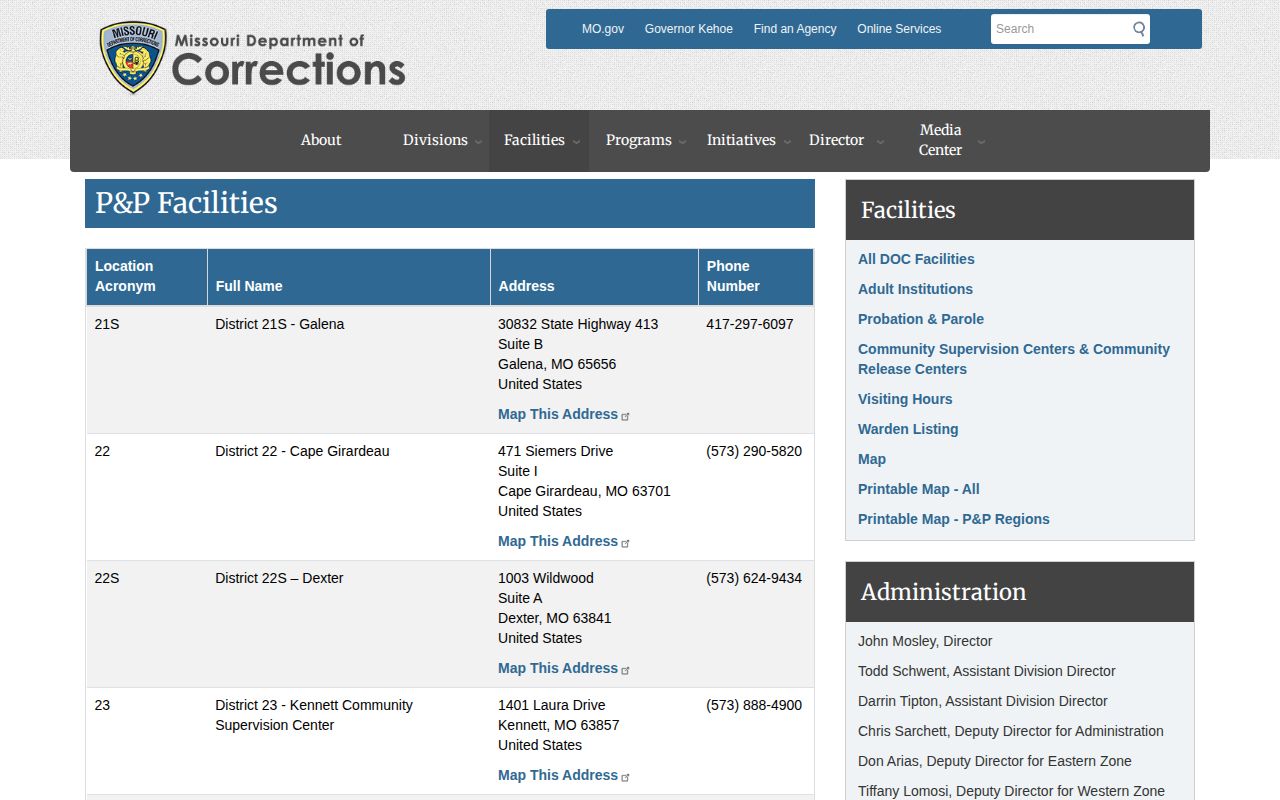
The listing is a verification route, not a public roster of everyone supervised in the county.
Lafayette County Violations and Absconders
Conditions depend on the judgment, Board decision, and case plan. A violation report does not establish the final outcome. The supervising officer and, for parole, the Board act within their authority. Case.net may show a court probation warrant or revocation filing, while MODOC addresses parole and conditional-release status.
Under RSMo §217.720, Probation and Parole may issue a warrant for an alleged parole or conditional-release violation. The person may be detained without bail pending the process. An unserved warrant makes the person a fugitive under the statute. An older release date and a current warrant can both be accurate.
An absconder is not finally discharged. Missouri's limited Sex Offender Registry also uses an Absconder status, but that registry is not a general parole search. Absence from it says nothing about someone without a registration duty.
Note: Confirm a warrant through the court or supervision office; a third-party listing may be stale, incomplete, or attached to the wrong person.
Missouri Compliance Credits and Discharge
Missouri Earned Compliance Credits concern eligible community supervision, not prison good time. Under RSMo §217.703, an eligible person may receive thirty days of credit for each full calendar month of compliance. Credits do not accrue during a violation-report month, custody, suspension, absconder status, or another ineligible period.
Credits can affect an eligible discharge date, but they are not a personal release calculator. The law includes conditions for final early discharge, including completion of restitution and at least two years served. MODOC describes its notice and calculation process on the early-discharge page. The assigned officer should explain the official case calculation.
Supervision ends only when the controlling authority enters a valid discharge or completion. Probation may end through court action. Parole or conditional release ends through MODOC and Board procedures. A warrant, violation, custody period, or other ineligible interval can interrupt the calculation.
The timing record also needs the right label. A probation term in a Lafayette County judgment is not the same as a parole date in a Board record. A conditional-release date is not a final discharge date. When asking District 29 about an apparent completion, identify the supervision type and ask whether the department still regards the case as active, whether an Earned Compliance Credit calculation applies, and which authority enters the final discharge.
Missouri Parole Decisions for Lafayette Cases
The Missouri Parole Board alone orders parole within its authority. RSMo §217.690 says parole is not a pardon or sentence reduction. Eligibility depends on sentence and offense, and reaching an eligibility point does not guarantee release.
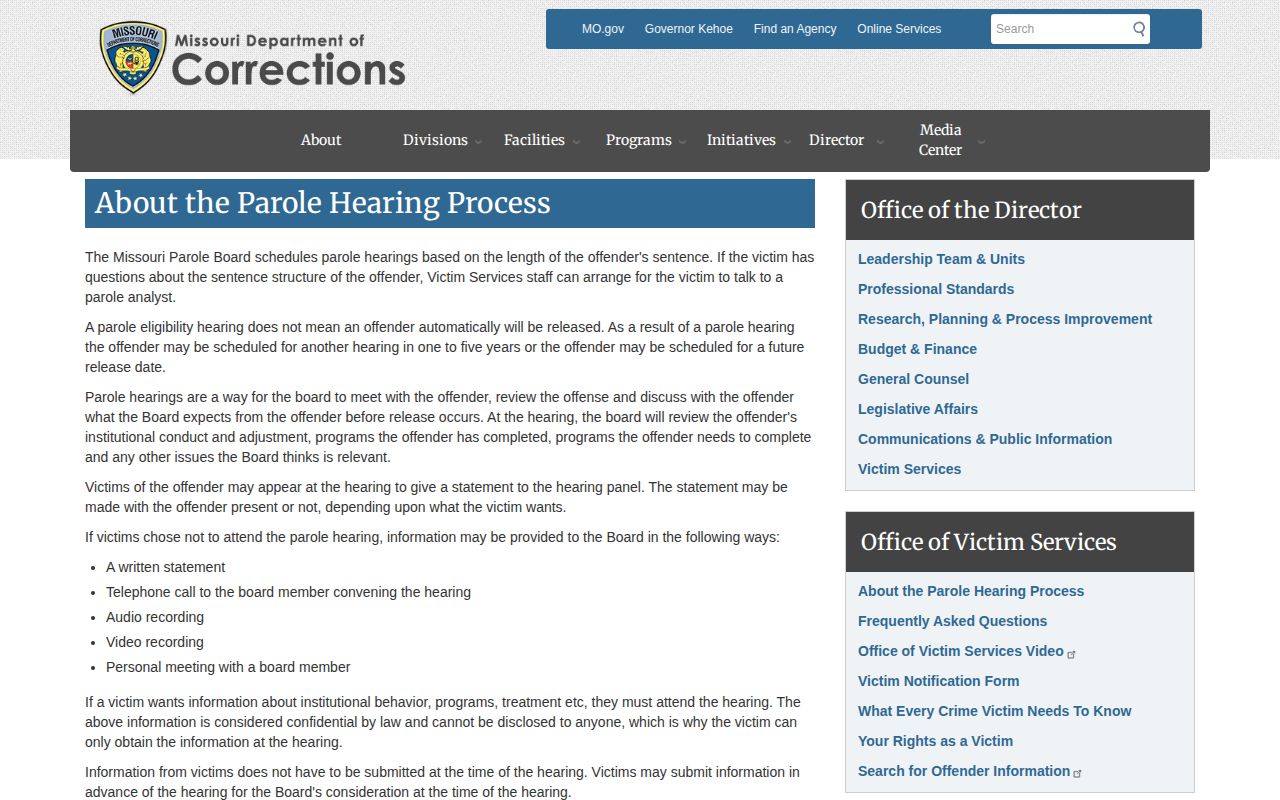
No public individual Missouri hearing calendar or searchable decisions database was found in the official sources. The route is the Board process page, institutional parole office, direct Board contact, the published Board rules, or a focused Sunshine request. The hearing process says a decision may set another hearing one to five years away or a future release date, and written decisions may take roughly eight to twelve weeks.
The official process image explains why a scheduled hearing is not a release order.
For an open but unpublished decision, identify the person by DOC ID and approximate hearing date in a request to ParoleBoard.SunshineRequest@doc.mo.gov.
Lafayette County Parole Outcomes
A practical Board-result inquiry should distinguish a grant, denial, deferment, and later rescission or extension. A grant or a future date can still depend on an approved release plan and later case events. A denial may set reconsideration. A deferment may mean that more information or later action is needed. Use the written decision's wording rather than assuming that attendance at a hearing proves Lafayette County community release.
Section 217.690 supplies context for Board authority, review, hearings, and consecutive sentences. It does not create a public decisions database or make release automatic. The institutional parole office remains the case-level route for a scheduled hearing, release plan, or decision whose open portion is not posted online.
Finding Lafayette County Final Discharge
After final MODOC discharge, the active search may show nothing because discharged offenders are excluded. The nightly Sunshine file is the better historical route. Review all charge-level rows with the same DOC ID, since one completed row does not establish that every sentence is complete. A direct request is appropriate when the working file is unclear.
For Lafayette court probation, read the Case.net judgment and docket in sequence. The Lafayette County Circuit Clerk handles local court-record inquiries when an open copy is unavailable online. Completion, revocation, a warrant, or a closed record can change what appears. Expungement or sealing may remove a case from ordinary view without destroying the record.
If the first question is whether county custody ended, use the Sheriff detention page and jail information line. A documented booking or release entry can be sought through the Lafayette County Sunshine form. Those local records do not replace the state supervision record.
Missouri's active search, historical data, local office, and court docket each answer a narrower question. Using them together is the sound way to verify whether a released Lafayette County person remains on parole or probation or has reached final discharge.
Lafayette County Supervision Notifications
MOVANS can add a custody-change or court-event notice where the reporting source participates, but it is not a certified supervision record. Current Missouri notification channels are SMS and email. Telephone and VINELink-app notices ended in May 2026. Local jail and court registration help comes from MOVANS at 573-526-1929, while MODOC custody registration help comes from the department at 573-526-6516. Route the question to the system that owns the record.
A Lafayette County Detention Center release record can show the county departure, while the court judgment explains probation and MODOC explains parole or conditional release. No one channel replaces the others. If the records conflict, preserve the exact labels and dates and ask the responsible custodian to explain its own entry.
The nightly MODOC file deserves careful reading after discharge. It uses charge-level rows, so several rows may share one DOC ID. A completed flag on one row does not prove that every sentence or supervision term is complete. Compare the case number, sentence county, sentence dates, field-versus-institution indicator, and all rows tied to the same identifier before seeking confirmation from MODOC.