
Lafayette Detention Center Release Paths
The Lafayette County Sheriff’s Office detention page identifies this as the county jail for people arrested in Lafayette County by municipal police, the Missouri State Highway Patrol, the Missouri Department of Conservation, federal agencies, and other law enforcement. That shared booking point does not make every exit the same. The release or movement entry should be read for its type and destination, not merely for the fact that the person is no longer housed at the detention center.
A local release may follow bond, a court order, dismissal, completion of a jail term, or another lawful direction. In that situation, the sheriff’s booking or release record is the primary county source. A transfer to the Missouri Department of Corrections ends the county-jail stay but does not mean the person entered the community. A transfer to a federal or immigration authority also continues custody elsewhere. Use the receiving system after confirming the county movement.
| Recorded path | Best next source | What it means |
|---|---|---|
| Local release | Sheriff record and Case.net | County custody ended; the court case may continue |
| Transfer to MODOC | MODOC active Offender Search | State custody or active supervision may continue |
| Federal transfer | Receiving authority, federal docket, BOP when applicable | The county departure is not proof of community release |
| Transfer to ICE | ICE detainee locator when the record supports that path | Immigration custody may have begun |
Confirm a Lafayette Jail Release
No official live roster, recent-release archive, or released-person search was found in the sheriff’s published navigation. A person’s absence from an online list therefore cannot establish release. Start with the jail and build a short record trail. The Lafayette County Sunshine request form provides the formal route when a phone answer is not enough or a copy is needed.
- Call the jail at 660-259-6682. Ask whether the person remains in county custody and how to request the public release or movement entry.
- Use the county Sunshine form and select Sheriff. Identify the person, booking or arrest date range, and the specific release fields sought.
- Check Missouri MOVANS for a custody change or notification. Treat a notice as a prompt to verify, not as a certified release record.
- Review Missouri Case.net for the Lafayette County criminal case, disposition, bond event, sentence, or later hearing.
- If the county record shows a transfer, continue with MODOC, BOP, ICE, the federal docket, or the named receiving agency.
Leaving the Lafayette County Detention Center is not always release to the community. A transfer ends one jail stay while custody continues elsewhere.
The full county search and release-record process is covered on the Lafayette County released inmates home page. It also explains how county, state, court, and notification records fit together.
Lafayette Release Records Contact
The detention center and sheriff are the first contacts for a Lafayette County jail release. The official sources publish a jail-specific line as well as the sheriff’s main number. No public release-processing hours, release door, family waiting rule, or property-return procedure was located. Ask the jail directly before traveling to Lexington or arranging pickup.
Lafayette County Detention Center
107 South 11th Street
Lexington, MO 64067
Jail: 660-259-6682
Sheriff: 660-259-3622
Fax: 660-259-2545
Email: info@lafayettecountymosheriff.gov
For a written record, use the county Sunshine process and direct the request to the Sheriff. Missouri law requires action or a response by the end of the third business day, but complex production can take longer. The response may explain the delay and provide the earliest expected availability. Ordinary paper copies no larger than 9 by 14 inches may cost up to ten cents per page, plus allowed staff and research costs.
Note: Ask for an advance cost estimate and electronic delivery in the record’s existing format when practical.
Lafayette Detention Release Record Fields
A “release record” may mean more than one document. The sheriff may hold a booking sheet, movement log, arrest report, bond document, court order, or release entry. A focused request helps the custodian locate responsive material and makes it easier to separate open portions from information restricted by law.
| Requested field | Why it matters |
|---|---|
| Booking identifier | Connects the request to the correct jail stay |
| Arresting agency | Identifies which agency initiated the custody event |
| Booking date and time | Defines the start of the detention-center record |
| Release date and time | Shows when county custody ended, if maintained and open |
| Release type or destination | Distinguishes community release from transfer |
| Bond or release authority | Connects the movement to the legal basis |
| Booking photograph | Helps confirm identity, subject to applicable limits |
The sheriff’s public pages do not publish a local release-code dictionary. Terms such as bond, court order, time served, dismissal, and transfer are useful request language, but they should not be presented as confirmed database labels. Ask for the actual value used in the responsive record. No fixed Lafayette County retention period was verified, so ask which retention schedule applies if an older file is not readily found.
Lafayette Release Court and DOC Checks
The Missouri Case.net portal can preserve public case information after a county jail stay ends. Limit the search to Lafayette County or the 15th Judicial Circuit, then inspect the Case Header, Charges/Judgments, and Docket Entries. The courts explain public record access, while the Track This Case instructions cover event updates. Bond, dismissal, sentence, probation, warrant, and revocation entries may explain the legal setting. A court docket does not prove the exact physical hour of release unless it expressly reports that fact.
When the jail record shows transfer to MODOC, use the MODOC active Offender Search. It covers active prisoners, probationers, and parolees. It expressly excludes discharged offenders. If a person no longer appears and final discharge is possible, the MODOC Sunshine page and nightly historical data are the correct state route. Match DOC ID, name, date of birth, county, case, and charge rows with care.
- Release
- The end of a stated custody event, which may or may not place the person in the community.
- Transfer
- A move from one custodian to another.
- Discharge
- The end of a correctional agency’s custody or supervision relationship.
- Detainer
- A request or notice tied to another authority’s custody interest.
Lafayette Detention Center Profile
The sheriff describes the Lafayette County Detention Center as a 126-person facility. Five custody pods account for 116 spaces, and a work-release pod has ten. Those figures describe design capability, not the current jail population. The detention center holds people arrested in the county by several local, state, conservation, and federal agencies, but that fact does not establish a permanent federal or ICE contract.
Published historical figures provide context but not today’s release count. The sheriff reports 2,031 bookings, an average daily count of 125, and a daily high of 152 in 2017. For 2016, it reports 2,200 bookings, an average of 137, and a high of 170. The 2015 figures are 1,930 bookings, an average of 120, and a high of 146. These dated statistics cannot be converted into a current daily release estimate.
Lafayette Jail History and Release Context
The current facility’s official history links several distinct dates. Lafayette County’s former jail was built in 1939 under the Federal Works Administration. It was designed for 72 people, while the history says safety concerns held the practical count near 60. A county law-enforcement tax approved in 2002 supported a replacement.
The present detention center accepted its first inmates on September 23, 2004. The same official account describes the project as “completed in 2005.” Both points should be kept because they refer to the facility’s rollout in different terms. Older articles, documents, and memories may point to the former jail, so confirm the current South 11th Street address when requesting a Lafayette County Detention Center release record.
The ten-space work-release pod is part of the current design. Work release is not proof that a named person left custody, and it does not replace the release entry. Movement connected to a work-release program should be verified with the jail record in the same way as another county custody change.
Lafayette Federal Transfer Checks
The facility has housed people arrested by federal agencies, but the official material reviewed did not substantiate a separate federal prison, ICE facility, or standing federal contract in Lafayette County. A federal arrest alone does not tell a reader whether USMS, BOP, or ICE later became the custodian. The county movement entry should identify the receiving authority when that field is maintained and open.
The official ICE detainer explanation shows why the destination matters. A detainer can request notice and a hold so ICE can assume custody. A transfer to ICE is not community release. The ICE locator and its published scope cover current detention and releases within the prior 60 days, subject to exclusions and delays. For a federal criminal transfer, use the BOP locator and its record definitions after a person enters that system. USMS pretrial custody may instead require the federal docket, clerk, detaining facility, or an agency records route.
The official ICE detainer page shown below is relevant only when a Lafayette record shows an immigration transfer or detainer.
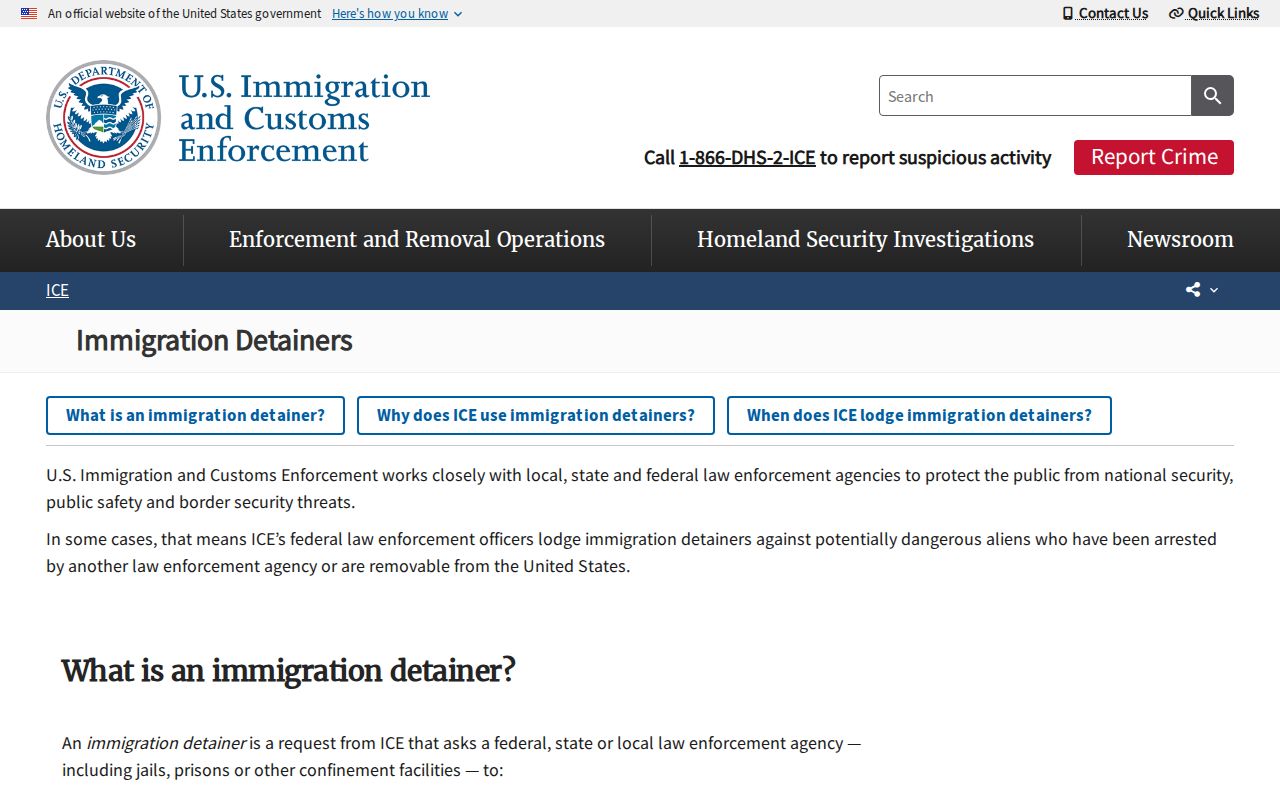
Its detainer context supports the key distinction: leaving the county jail for ICE changes custodians rather than confirming freedom from custody.
Lafayette Release Details Not Published
Several practical details were not found in the official Lafayette sources. The sheriff does not publish a release-processing time, public release door, family waiting rule, property-return method, local good-time formula, weekend-release rule, bond schedule, current release count, mobile app, booking-photo gallery, or recent-release archive. Those gaps should remain explicit.
Ask direct, narrow questions instead of relying on custom at another jail. Confirm the permitted pickup place, whether property is ready, and when a public counter or phone line can answer. If transportation is being planned, coordinate it only after the detention center gives case-specific timing. The absence of a public detail does not prove that no internal policy exists.
Note: A missing public search result means “not found in that source,” not that no custody or release record exists.