
Lafayette County Projected vs Actual Release
A projected date is a sentence or corrections calculation based on facts known at that time. The actual release date is when the holding authority completes a release, transfer, or discharge. A Lafayette County jail departure may be bond, court order, time served, transfer, or another recorded outcome. A transfer to MODOC, ICE, federal custody, or another jail is not community release.
A pretrial detainee usually has no computed sentence end. Bond may be posted, a court may change custody, or another hold may block release. Case.net can show an order or judgment, but the Lafayette County Detention Center record establishes when the jail carried it out. Sentenced people have more date fields, yet those fields still require context.
Find a Lafayette County Inmate Release Date
Choose the route by custody system. Missouri prison sentence fields cannot be applied to a county-jail term, and the county cannot certify a later state or federal release.
- For Lafayette County Detention Center custody, call 660-259-6682 and ask whether the person remains held. Request the booking/release record through the county Sunshine form when a documented time or destination is needed.
- Open Case.net and review the Lafayette County Case Header, Charges/Judgments, and Docket Entries. The Circuit Clerk is the local copy fallback.
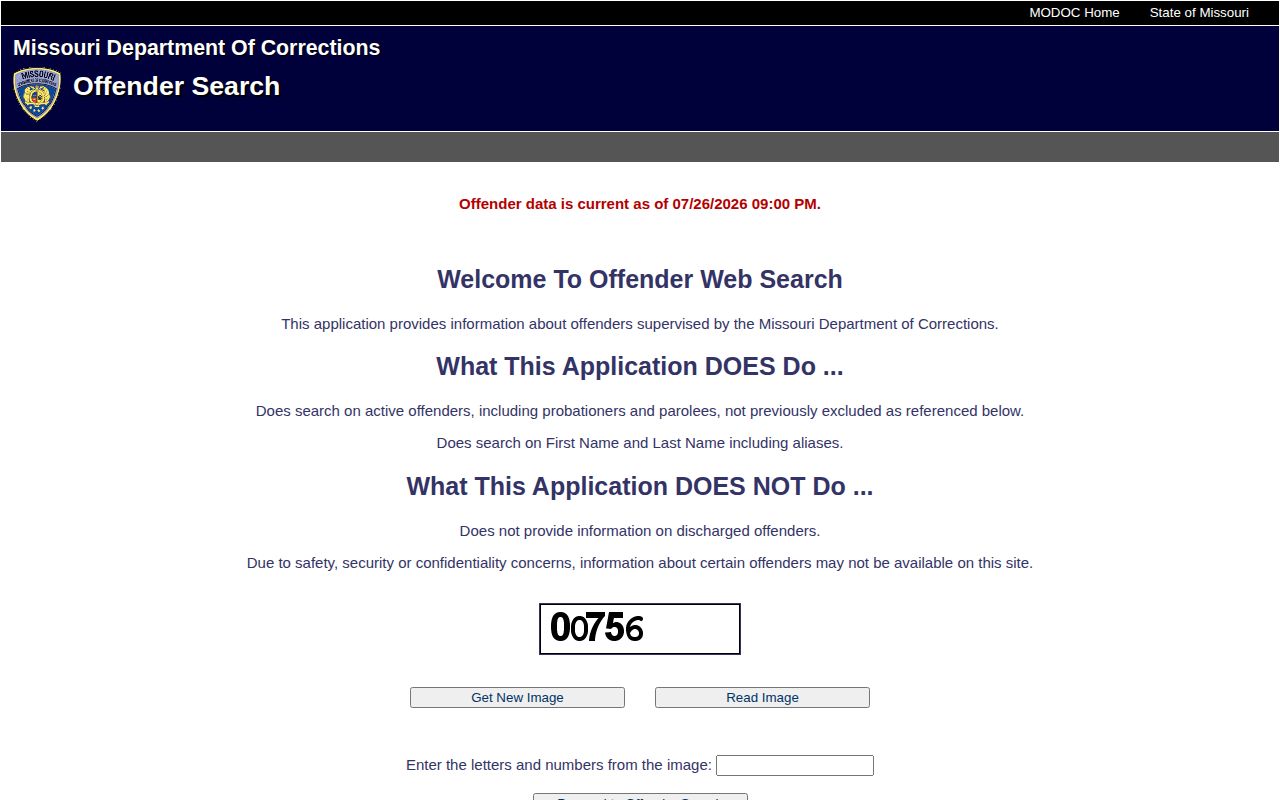
- For active MODOC custody or supervision, use the active Offender Search. It is CAPTCHA-protected and excludes fully discharged offenders.
- For sentence-date fields and former MODOC cases, consult the nightly Sunshine data and layout. Match DOC ID and review every charge-level row.
- Confirm parole or conditional-release questions with the institutional caseworker, Parole Board, or District 29. A displayed date does not replace a case-level decision.
The broader Lafayette County released inmates guide covers custody changes after a county-jail departure. Note: Use a DOC ID, booking number, and case number where possible; name-only matches can join unrelated people and sentence rows.
Missouri Minimum and Maximum Release Fields
The verified MODOC layout uses the exact labels “Sentence-I Minimum Release Date” and “Sentence Maximum Release Date.” The research did not verify that a live active-search result displays a field called “projected release date,” so that claim should not be made. The nightly file also includes DOC ID, sentence date, sentence length, completed flag, court case number, charge data, and an institution-versus-field indicator.
The official active search screenshot shows its role and the exclusion of discharged offenders.
A person absent from this active portal may be discharged, protected from display, unmatched, or outside MODOC. Absence alone does not establish release.
| Field | What it can support | What it cannot prove alone |
|---|---|---|
| Minimum Release Date | An earliest sentence-related threshold in the MODOC layout | The day the person will leave an institution |
| Maximum Release Date | Sentence structure at the time of the record | A guaranteed final discharge after later events |
| Completed Flag | Completion status for a particular row | Completion of all rows with that DOC ID |
| F/I indicator | Field versus institutional assignment | A home address or release destination |
Lafayette Historical Release Date Data
The historical file is a working dataset rather than a polished person profile. MODOC warns that completion and accuracy are not guaranteed and that some information may be self-reported. Its sentence rows should be reconciled by DOC ID, court case, sentence county, charge, and completed flag. Where a minimum or maximum date conflicts with a judgment or another row, preserve both records and ask MODOC to explain its computation.
The file can reach back as early as 1974, which makes it valuable after the active portal stops returning a finally discharged person. The official nightly ZIP download is the data source, but that date range is not a promise that every historical event is complete. A focused Sunshine request remains the sound next step when the row structure does not answer whether all sentences ended.
Missouri Sentence Rules Affecting Release Dates
RSMo §558.019 requires a person convicted of a statutorily defined dangerous felony to serve at least eighty-five percent of the court sentence, or until age seventy after serving at least forty percent, whichever occurs first. This is not a rule that every Missouri prisoner serves eighty-five percent. The conviction, offense date, sentence, and applicable statutory version matter.
RSMo §558.011 divides qualifying non-dangerous felony terms into prison and conditional-release portions. For terms of nine years or less, the conditional portion is one-third; for more than nine through fifteen years, it is three years; for more than fifteen years, it is five years. Conditional release remains supervised and may be extended through the statutory process for institutional violations.
Parole is a Board decision, conditional release is a statutory sentence portion, and Earned Compliance Credits under §217.703 apply to eligible community supervision. Calling all three “good time” hides important distinctions. None should be converted into a release promise without the official sentence computation.
The special calculations inside §558.019 also need restraint. Treating life as thirty years or an aggregate above seventy-five years as seventy-five serves the statute's specified minimum-term calculation. It does not rewrite the judgment into a shorter sentence. Likewise, the conditional-release fractions in §558.011 describe qualifying sentence structure; later institutional violations can lead the Board to extend the conditional-release date after the required process.
Why Lafayette County Release Dates Change
A sentence field can remain valid as a record of a calculation while the practical exit date moves. Later orders, other custody, Board action, and conduct can all matter.
| Factor | Possible effect | Confirm with |
|---|---|---|
| Institutional violation | Conditional release may be extended after required process | MODOC caseworker or Board record |
| Parole grant, denial, deferral, or rescission | A future release may be set, postponed, or changed | Written Parole Board decision |
| New or amended court order | Sentence, bond, or custody authority may change | Case.net and court clerk |
| Detainer or receiving agency | Departure from one facility becomes transfer, not community release | Holding and receiving agencies |
| Violation warrant or absconder period | Community supervision credit may stop and custody may resume | District 29, court, or Board |
| Concurrent or consecutive terms | Multiple sentence rows change the overall computation | MODOC sentence specialist |
A Lafayette County jail record may use a release type or destination if maintained and open. Ask for that field. “Released to MODOC” records a handoff, not freedom from custody.
Does Lafayette County Jail Use Good Time?
No official Lafayette County good-time formula or weekend-release rule was found on the Sheriff detention page or other local sources reviewed. Missouri prison formulas should not be applied to a Detention Center sentence. Obtain the sentencing judgment and commitment, then ask the jail how it applied credit for time served, the commitment start, sentence length, and release authority.
The county Sunshine request can name the executed release record, date and time, release type or destination if maintained and open, and the order or authorization used. Under §610.023, the custodian responds as soon as possible and no later than the end of the third business day. That is a response deadline, not guaranteed final production.
This local gap is important. A calculated date based on unsupported assumptions can be wrong even when the arithmetic looks neat. Only the jail and court can explain a Lafayette County jail-term calculation.
A useful local inquiry separates four items: the commitment start date, credit for time already served, the sentence length in the judgment, and the legal authority for release. Ask whether any other agency hold affects the physical departure. If the answer is transfer to MODOC or another custodian, request the movement date and receiving agency rather than reporting it as release to the community.
Confirm a Lafayette County Release Date
MOVANS, delivered through VINELink, can provide a custody-change notice where the relevant local or state data participates. Since May 5, 2026, Missouri ended telephone and VINELink-app notifications; current channels are SMS and email. MOVANS is useful for prompt notice, but it is not the sheriff's certified release log.
For help with a local jail or court registration, use movans@dps.mo.gov or 573-526-1929. For MODOC custody registration, use victims@doc.mo.gov or 573-526-6516. The VINELink Release Check explains the current registration path.
Confirm a Lafayette County jail event with the Detention Center or Sheriff record, a state event with MODOC, and a Board date with the written decision. If federal or immigration custody follows, use BOP or ICE. The last custodian's departure record and the next custodian's status together prevent a transfer from being mislabeled as release.
Federal Release Dates After Lafayette
The BOP locator can show a federal release date and a “RELEASED” location for people no longer in BOP custody, but that label does not rule out supervised release or custody elsewhere. ICE's locator covers current detention and releases within the preceding sixty days, subject to delays and omissions. USMS pretrial custody has no comparable general released-person locator. Use the federal docket, clerk, detaining facility, or the responsible agency when a Lafayette County record shows a federal handoff.
A county entry marked released to a federal or immigration authority records a custody transfer. Match the Lafayette movement date to the receiving system, and do not treat a negative BOP result as proof that a USMS detainee was released. The federal docket or receiving facility may be the only current source before BOP designation.
Match Lafayette County Release Records
For the strongest confirmation, pair two records that answer different parts of the question. A sheriff release entry plus a Case.net order can explain a county departure. A MODOC sentence row plus a supervising-office answer can distinguish institutional release from final discharge. Record the exact status wording instead of shortening every event to “released.”
Identity checks are part of date verification. The strongest MODOC match uses DOC ID, name, date of birth, sentence county, and court case. Because the nightly file is charge-level, several rows can belong to one person. Review overlapping and consecutive terms together. The strongest Lafayette County jail match uses booking number, booking date, date of birth, arresting agency, and court case. A booking charge may later be amended, so differences between the jail record and judgment can reflect normal case progress rather than an error.
If the MODOC file conflicts with the court judgment, ask each office about the record it owns. The Circuit Clerk maintains the judgment. MODOC explains its sentence calculation. District 29 handles active community-supervision questions. Do not ask one agency to rewrite another agency's entry. Keep the records side by side until the source of the date difference is clear.
Parole Timing for Lafayette Releases
Board timing adds another layer. Missouri's hearing process says an eligibility hearing can produce a later hearing one to five years away or set a future release date, and written decisions may take about eight to twelve weeks. Eligibility is not an order to release. A future Board date may still change because of an unapproved plan, later violation, warrant, rescission, or another lawful custody event.
Use the institutional parole office for a case-level explanation and the written Board decision for the outcome. Where an open decision is not published, a focused Sunshine request should identify the DOC ID and approximate hearing period. Do not substitute a general Board page for an individual release order.